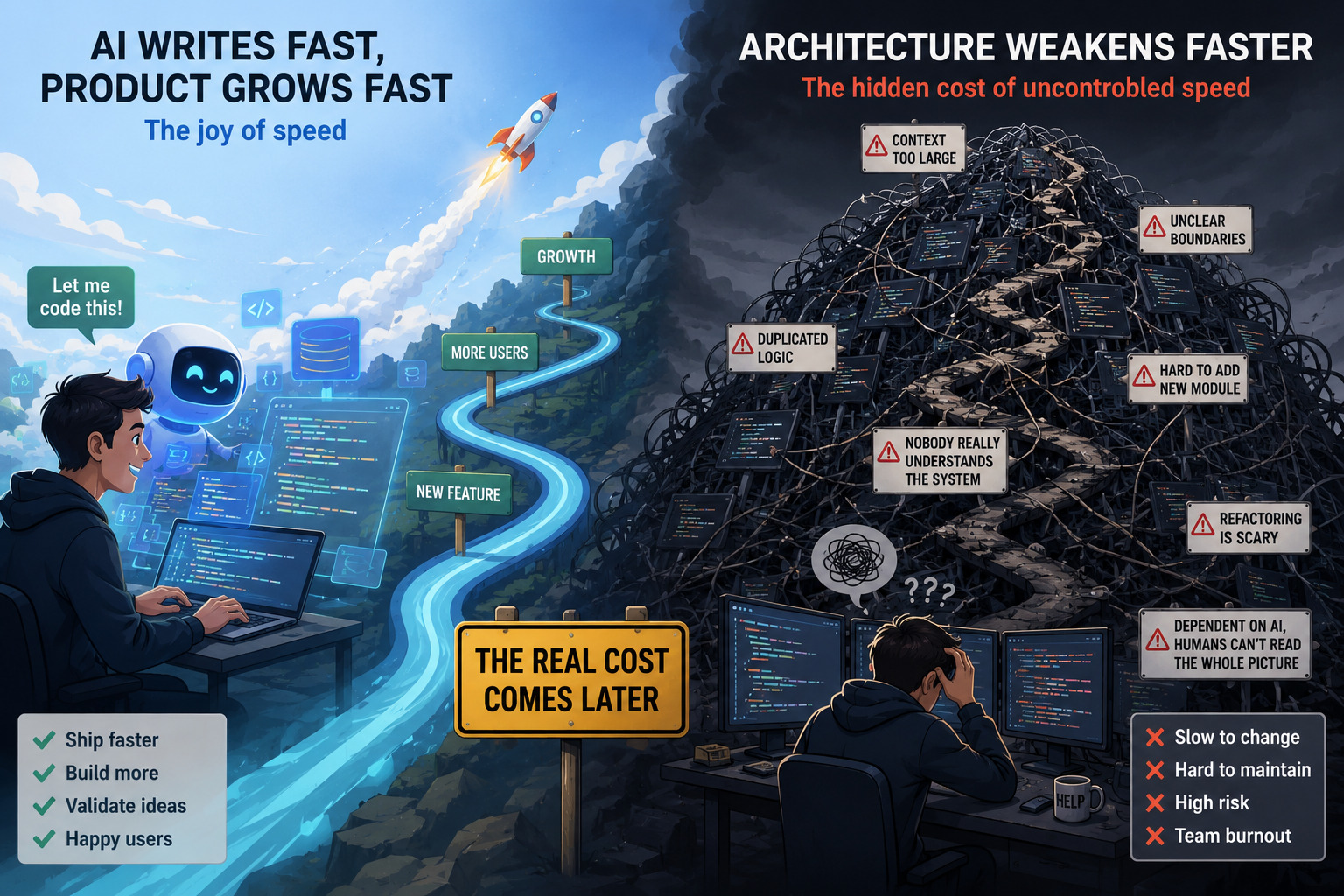
The real problem is this:
Humans gradually stop having a strong enough mental model of the system that AI helped create too quickly.
That is the dangerous part.
At that point, the team can still keep shipping.
But usually in a fragile way:
- Patching locally
- Prompting one piece at a time
- Attaching more code just to make it work
- Fixing parts without seeing the whole system clearly
The result is:
- The product grows faster
- But the architecture weakens faster
- There is more code
- But less real ownership
- Velocity looks high early on
- Maintainability drops hard later
Eventually, the bottleneck is no longer:
“Can we produce code fast enough?”
The bottleneck becomes:
- Does anyone still understand the system?
- Does anyone still know how to elevate the architecture?
- Does anyone still feel confident adding new modules without damaging existing ones?
That is why I think:
Writing code faster with AI is the easy part.
Keeping the system alive once it becomes large is the hard part.
AI should accelerate implementation.
But architecture, boundaries, ownership, and structural judgment still need to stay with humans.
Otherwise, the cost of speed arrives very quickly:
The product still runs, but nobody is confident enough to take it to the next level.